RoverBot
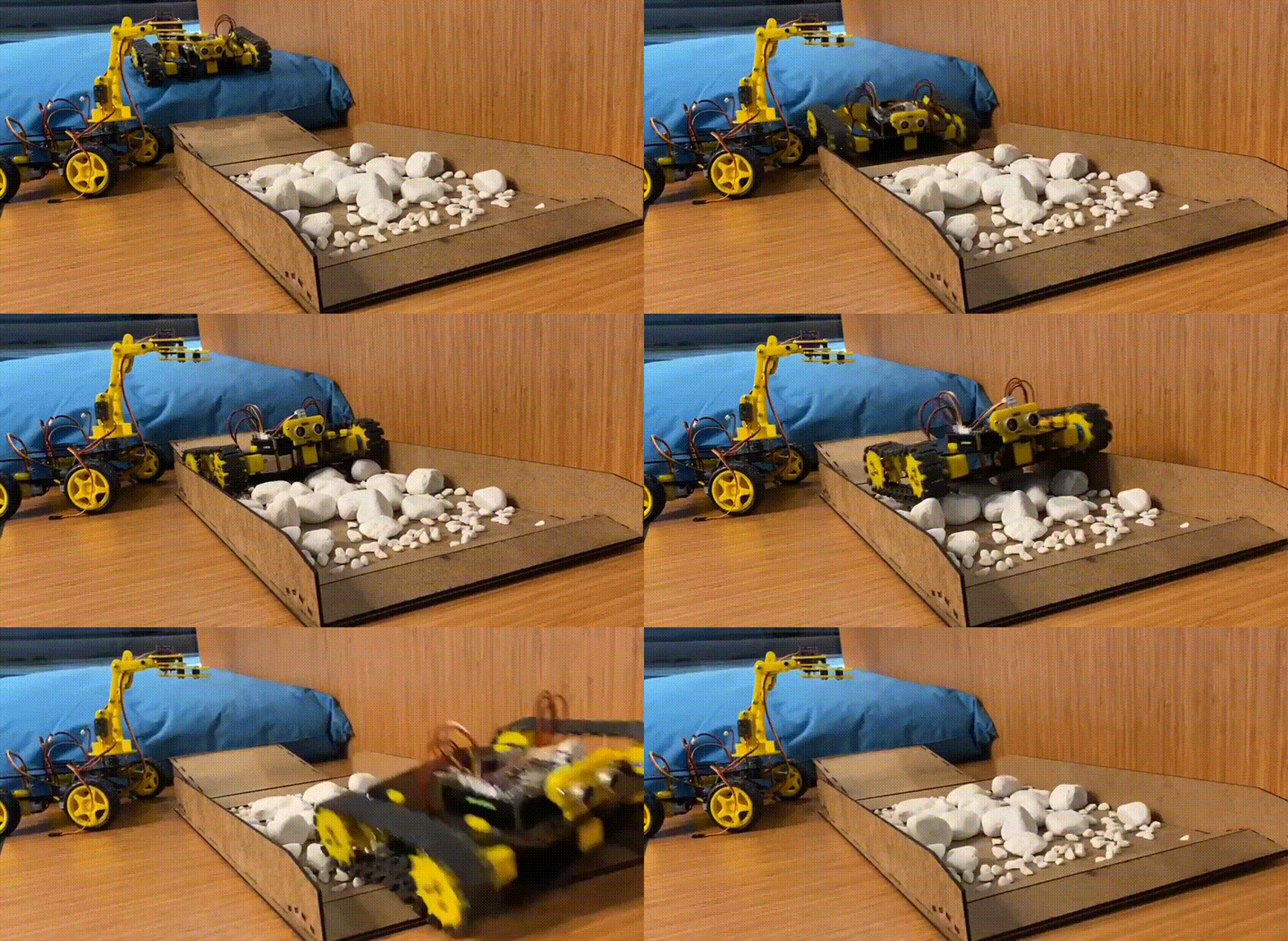
RoverBot is a REX robot that allows you to move comfortably in difficult terrain conditions thanks to its crawler structure. With RoverBot, you can perform tasks that require rough, difficult terrain. Like other REX 8 in 1 robots, you can control the RoverBot remotely if you want, or you can move it autonomously with the code you wrote in it.
RoverBot Arduino C Code
//"""REX 8in1 Rover Bot"""
//Check the web site for Robots https://rex-rdt.readthedocs.io/en/latest/
#include <DabbleESP32.h>
#include <Arduino.h>

//Define Motor Pins
#define MotorA1 15 // Forward
#define MotorA2 23 // Backward

#define MotorB1 32 // Forward
#define MotorB2 33 // Backward

#define MotorC1 5 // Forward
#define MotorC2 4 // Backward

#define MotorD1 27 // Forward
#define MotorD2 14 // Backward

//define buzzer pin named "horn"
#define horn 25

void setup() {
  pinMode(horn, OUTPUT);

  pinMode(MotorA1, OUTPUT);
  pinMode(MotorA2, OUTPUT);

  pinMode(MotorB1, OUTPUT);
  pinMode(MotorB2, OUTPUT);

  pinMode(MotorC1, OUTPUT);
  pinMode(MotorC2, OUTPUT);

  pinMode(MotorD1, OUTPUT);
  pinMode(MotorD2, OUTPUT);

  Serial.begin(115200);  // make sure your Serial Monitor is also set at this baud rate.
  Dabble.begin("REX_ROBOT"); //set bluetooth name of your device
}

void loop() {
  Dabble.processInput();
  stop();
  if (GamePad.isUpPressed())
  {
    forward();
  }

  if (GamePad.isDownPressed())
  {
    backward();
  }

  if (GamePad.isLeftPressed())
  {
    left();
  }

  if (GamePad.isRightPressed())
  {
    right();
  }

  if (GamePad.isSquarePressed())
  {
    Serial.print("Square");
  }

  if (GamePad.isCirclePressed())
  {
    Serial.print("Circle");
  }

  if (GamePad.isCrossPressed())
  {
    Serial.print("Cross");
    digitalWrite(horn, HIGH);
    delay(100);
    digitalWrite(horn, LOW);
  }

  if (GamePad.isTrianglePressed())
  {
    Serial.print("Triangle");
  }

  if (GamePad.isStartPressed())
  {
    Serial.print("Start");
  }

  if (GamePad.isSelectPressed())
  {
    Serial.print("Select");
  }
}

void forward() {
  digitalWrite(MotorA1, HIGH);
  digitalWrite(MotorA2, LOW);

  digitalWrite(MotorB1, HIGH);
  digitalWrite(MotorB2, LOW);

  digitalWrite(MotorC1, HIGH);
  digitalWrite(MotorC2, LOW);

  digitalWrite(MotorD1, HIGH);
  digitalWrite(MotorD2, LOW);
}

void right() {
  digitalWrite(MotorA1, HIGH);
  digitalWrite(MotorA2, LOW);

  digitalWrite(MotorB1, HIGH);
  digitalWrite(MotorB2, LOW);

  digitalWrite(MotorC1, LOW);
  digitalWrite(MotorC2, HIGH);

  digitalWrite(MotorD1, LOW);
  digitalWrite(MotorD2, HIGH);
}

void left() {
  digitalWrite(MotorA1, LOW);
  digitalWrite(MotorA2, HIGH);

  digitalWrite(MotorB1, LOW);
  digitalWrite(MotorB2, HIGH);

  digitalWrite(MotorC1, HIGH);
  digitalWrite(MotorC2, LOW);

  digitalWrite(MotorD1, HIGH);
  digitalWrite(MotorD2, LOW);
}

void stop() {

  digitalWrite(MotorA1, LOW);
  digitalWrite(MotorA2, LOW);

  digitalWrite(MotorB1, LOW);
  digitalWrite(MotorB2, LOW);

  digitalWrite(MotorC1, LOW);
  digitalWrite(MotorC2, LOW);

  digitalWrite(MotorD1, LOW);
  digitalWrite(MotorD2, LOW);

}

void backward() {
  digitalWrite(MotorA1, LOW);
  digitalWrite(MotorA2, HIGH);

  digitalWrite(MotorB1, LOW);
  digitalWrite(MotorB2, HIGH);

  digitalWrite(MotorC1, LOW);
  digitalWrite(MotorC2, HIGH);

  digitalWrite(MotorD1, LOW);
  digitalWrite(MotorD2, HIGH);
}
RoverBot MicroPython Code
from machine import Pin, PWM
import bluetooth
from rex import BLESimplePeripheral
import time

# Create a Bluetooth Low Energy (BLE) object
ble = bluetooth.BLE()

# Create an instance of the BLESimplePeripheral class with the BLE object
sp = BLESimplePeripheral(ble)

#motorA
motor_A1 = PWM(Pin(15))
motor_A1.duty_u16(0)
motor_A2 = PWM(Pin(23))
motor_A2.duty_u16(0)

#motorB
motor_B1 = PWM(Pin(32))
motor_B1.duty_u16(0)
motor_B2 = PWM(Pin(33))
motor_B2.duty_u16(0)

#motorC
motor_C1 = PWM(Pin(5))
motor_C1.duty_u16(0)
motor_C2 = PWM(Pin(4))
motor_C2.duty_u16(0)

#motorD
motor_D1 = PWM(Pin(27))
motor_D1.duty_u16(0)
motor_D2 = PWM(Pin(14))
motor_D2.duty_u16(0)

#buzzer
buzzer = Pin(25, Pin.OUT)

playBuzzer = 0
buzzerStartTime = 0

#default motor speed
MotorSpeed = 65535

def forward(speed):
   motor_A1.duty_u16(speed)
   motor_A2.duty_u16(0)

   motor_B1.duty_u16(speed)
   motor_B2.duty_u16(0)

   motor_C1.duty_u16(speed)
   motor_C2.duty_u16(0)

   motor_D1.duty_u16(speed)
   motor_D2.duty_u16(0)
   return

def backward(speed):
   motor_A1.duty_u16(0)
   motor_A2.duty_u16(speed)

   motor_B1.duty_u16(0)
   motor_B2.duty_u16(speed)

   motor_C1.duty_u16(0)
   motor_C2.duty_u16(speed)

   motor_D1.duty_u16(0)
   motor_D2.duty_u16(speed)

def right(speed):
   motor_A1.duty_u16(speed)
   motor_A2.duty_u16(0)

   motor_B1.duty_u16(speed)
   motor_B2.duty_u16(0)

   motor_C1.duty_u16(0)
   motor_C2.duty_u16(speed)

   motor_D1.duty_u16(0)
   motor_D2.duty_u16(speed)

def left(speed):
   motor_A1.duty_u16(0)
   motor_A2.duty_u16(speed)

   motor_B1.duty_u16(0)
   motor_B2.duty_u16(speed)

   motor_C1.duty_u16(speed)
   motor_C2.duty_u16(0)

   motor_D1.duty_u16(speed)
   motor_D2.duty_u16(0)

def stop():
   motor_A1.duty_u16(0)
   motor_A2.duty_u16(0)

   motor_B1.duty_u16(0)
   motor_B2.duty_u16(0)

   motor_C1.duty_u16(0)
   motor_C2.duty_u16(0)

   motor_D1.duty_u16(0)
   motor_D2.duty_u16(0)

# Define a callback function to handle received data
def on_rx(data):
    global buzzerStartTime, playBuzzer
    print("Data received: ", data)  # Print the received data

    if data == b'\xff\x01\x01\x01\x02\x00\x01\x00': #up
        forward(MotorSpeed)
    elif data == b'\xff\x01\x01\x01\x02\x00\x02\x00': #down
        backward(MotorSpeed)
    elif data == b'\xff\x01\x01\x01\x02\x00\x04\x00': #left
        left(MotorSpeed)
    elif data == b'\xff\x01\x01\x01\x02\x00\x08\x00': #right
        right(MotorSpeed)
    elif data == b'\xff\x01\x01\x01\x02\x04\x00\x00': #trigle
        print("trigle")
    elif data == b'\xff\x01\x01\x01\x02 \x00\x00': #square
        print("square")
    elif data == b'\xff\x01\x01\x01\x02\x08\x00\x00': #circle
        print("circle")
    elif data == b'\xff\x01\x01\x01\x02\x10\x00\x00': #cross
        buzzerStartTime = time.ticks_ms()
        playBuzzer = 1
        buzzer.value(1)
    elif data == b'\xff\x01\x01\x01\x02\x02\x00\x00': #select
        print("select")
    elif data == b'\xff\x01\x01\x01\x02\x01\x00\x00': #start
        print("start")
    else:
        stop()

while True:
    currentTime = time.ticks_ms()
    if (playBuzzer == 1) and (time.ticks_diff(currentTime, buzzerStartTime) > 1000):
         buzzer.value(0)
         playBuzzer = 0

    if sp.is_connected():  # Check if a BLE connection is established
        sp.on_write(on_rx)  # Set the callback function for data reception